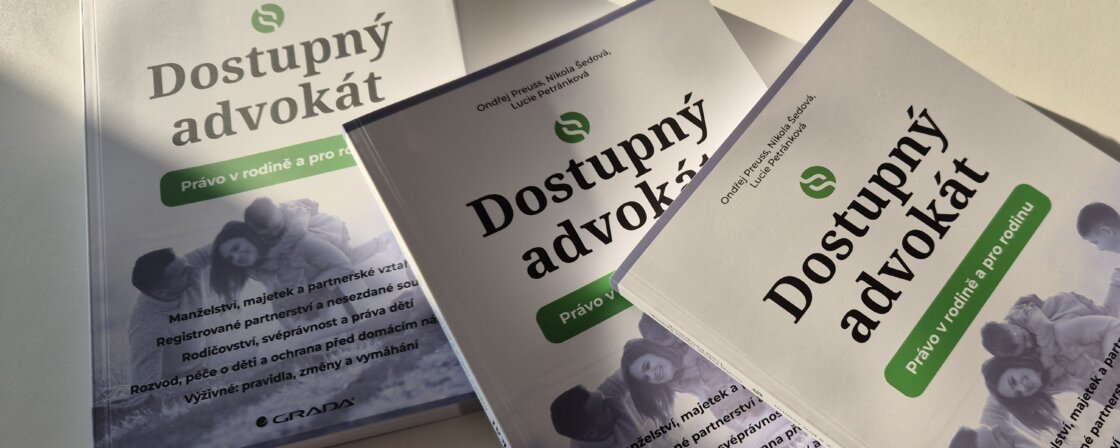
Why did we focus on the family?
Each of us is part of a family story. Some are positive – engagements, weddings, the birth of children. Others are more challenging – divorces, custody disputes, child support or community property issues. In all of these moments, the law comes into play. And the better we understand it, the more confidently we can make decisions in them.
In our experience, it is in family law that people most often flounder. Often they are dealing with personal and sensitive situations in which paragraphs and legal phrases can easily become a confusing jumble. That is why we decided to write a book that explains everything in a clear, factual and practical way.
What will you find in the book?
- You’ll learn what entering into marriage entails – not just symbolically, but also legally.
- We advise you on how to get to grips with the property relations between partners and when you can do without contracts.
- We explain how the law views cohabitation between unmarried couples or same-sex couples.
- We’ll look at what it all means in terms of parenting law – from establishing paternity to custody arrangements on separation.
- We also summarise the important changes to family law effective from January 2026 – including new rules for divorce and decision-making about children.
And, of course, there’s practical information on maternity and parental leave, maintenance, adoption, fostering, children’s and adolescents’ legal capacity, and how children acquire and manage property.
The authors of the book are JUDr. Ondřej Preuss, Ph.D., Mgr. Lucie Petránková and Mgr. O. Petranová, L. Petranová, L. Petranová and L. Nikola Šedová.
Buy a book from GRADA with 25% discount with code DOSTUPNYADVOKAT25
How is this book different from ordinary legal publications?
We write in language you can understand. Don’t expect dry interpretations of the law without context. Within the pages of this book you will find answers to questions that every other parent, partner or teenager is asking. Most chapters are interspersed with real-life stories from the practice of law and the courtroom.
Who is the book for?
For anyone who wants to be clear about relationships and the law – without unnecessary complications and, most importantly, without the hassle of
- parents and parents-to-be,
- students and teachers,
- social workers and counsellors,
- workers of the OSPOD or non-profits
- and anyone who deals with family law issues on a daily basis in practice.
When it may be useful:
- When you are planning a life together – in marriage or just “on the dog book”.
- When you’re dealing with a separation, divorce or need to arrange child custody
- When you’re worried about what will happen to your property after your partner’s death.
- When you’re struggling with unpaid child support or waiting for a court order.
- When you are affected by a proceeding for legal capacity, adoption or other major decision.
Download a free excerpt from the book