Quick Overview
What you can do through the MOJE daně portal:
- file a tax return, a control report, or other electronic filings,
- check recorded payments, overpayments, and any underpayments,
- track the status of your filings and view selected information from your tax file,
- set up alerts for important tax deadlines,
- grant access to DIS+, for example to an accountant,
- verify a VAT payer and their published bank accounts,
- apply for a VAT refund from another EU country, provided the legal requirements are met.
You’ll have access to the most features after logging in to the Online Tax Office and activating DIS+. You can also fill out the forms themselves in the EPO app, which performs automatic data checks and alerts you to certain errors.
While electronic filing simplifies communication with the tax office, it does not, on its own, assess which course of action is legally correct in your specific situation. If you are dealing with a tax audit, a notice from the tax administrator, or a dispute over an additional tax assessment, discuss your case with an attorney specializing in tax law.
The “Moje daně” ePortal—What Is It?
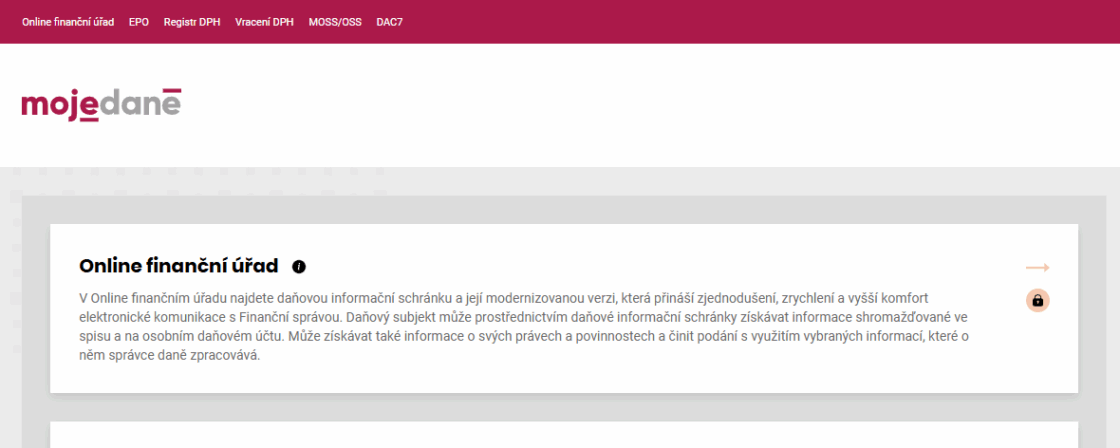
The “My Taxes” ePortal is the official portal of the tax administration, operated by the Ministry of Finance (MFČR). The portal allows citizens and businesses to conveniently manage their tax affairs online. After logging in, you’ll gain access to your online tax office—that is, the Tax Information Inbox (DIS+)—where you can track the status of your filings, view your tax file, keep track of payments, and communicate electronically with the authorities.
The MFČR Tax Portal also allows you to electronically fill out and submit tax forms ( such as tax returns or control reports), verify VAT payers by VAT ID number, file applications for VAT refunds from EU countries, and electronically sign documents using the ePodpisFS application.
Are you solving a similar problem?
Are you unsure how to handle your taxes properly so you don't make a mistake?
We’ll help you navigate not only the law—whether it involves resolving a specific tax situation, preparing for a tax audit, or defending yourself in court.
I'd like some advice
- When you order, you know what you will get and how much it will cost.
- We handle everything online or in person at one of our 6 offices.
- We handle 8 out of 10 requests within 2 working days.
- We have specialists for every field of law.
My Taxes – Log In
There are several ways to log in to the tax portal:
| How to Log In |
What You Need |
Who It’s For |
| Bank Identity |
Access to a supported online banking service |
For most regular users |
| eGovernment mobile key |
An activated app on your phone |
For users who log in via mobile |
| eID |
ID card with an activated chip, PIN, and card reader |
For holders of an activated eID card |
| NIA ID |
User account, password, and a second factor of authentication |
For users of Citizen Identity |
| mojeID |
A mojeID account with the required verification level |
For users with a verified mojeID account |
| Data Box |
Data Box login credentials |
For entrepreneurs, businesses, and other data box holders |
| Qualified certificate |
Valid certificate and necessary technical equipment |
Especially for professional users |
Nabídka konkrétních přihlašovacích prostředků se může měnit. Při přihlášení proto vždy vycházejte z aktuálních možností zobrazených přímo na portálu MOJE daně.
Via Citizen Identity
This option includes several ways to log in:
- eGovernment Mobile Key: The simplest and fastest way to log in using a free mobile app. Just scan the QR code from your computer screen, confirm on your phone, and you’re logged in—no passwords or codes required.
- eID Card: A chip-enabled ID card allows you to log in via a card reader and by entering a PIN. It is activated when you pick it up at the government office; a card reader can be purchased for approximately 200 CZK.
- NIA ID: An online identity with two-factor authentication—you log in using your name, password, and a one-time SMS code. Registration takes place online; activation is done via a data box, eObčanka, or Czech POINT.
- IIG: Login for foreign nationals.
- Bank Identity: You can also log in to the Moje daně portal using your bank identity (online banking)—supported by banks such as ČSOB, KB, Česká spořitelna, Air Bank, and others. It acts as a secure bridge between your bank and government agencies. Fast, no installation required, and no need to configure anything.
- MojeID: An online identity managed by the CZ.NIC association that allows users to create and manage an online identity. Once verified, this identity can be used to log in without having to create separate accounts for individual services.
- I.CA Identity: I.CA Identity is primarily intended for professional users. It uses a chip card with a qualified certificate and provides a high level of security. It is managed by První certifikační autorita, a.s.
Tip for article
ID cards with chips and e-IDs: How do they differ, and what are the benefits? The next article will tell you.
Via the Data Box
If you have a data box (individuals, sole proprietors, or companies), you can use it to log in. The login process involves redirection and identity verification through your data box login.
Using an electronic signature
You can also log in using a qualified electronic signature (e.g., a certificate stored on your computer).
Now let’s take a look at the features and applications offered by the Moje daně portal:
Online Tax Office (DIS+)
The Online Tax Office (DIS+) is a modern service provided by the Czech Financial Administration that allows you to keep track of your taxes and manage them conveniently from anywhere. Simply log in to immediately gain access to your personal tax information inbox.
DIS+ serves as a user-friendly online interface where you can find information about your tax account and the public portion of your tax file. It allows you to track filed returns, received payments, and any outstanding balances. Thanks to its integration with the EPO app, you can fill out and submit tax forms directly within the DIS+ interface, use automatic data pre-fill, save draft filings, and set up notifications or a personal tax calendar. The portal also makes it easy to grant access to another person —such as an accountant—and specify the scope of their permissions, without having to contact the tax office.
Electronic Filing for the Tax Administration (EPO)
The EPO (Electronic Filing for the Tax Administration) application is designed to help you conveniently and securely fulfill your tax obligations from the comfort of your home. It allows you to file VAT returns, income tax returns, and control reports online—all clearly and easily from your computer.
If your accountant has prepared the form for you, you can easily import it in XML format, edit it, and submit it. You can submit your filing with or without an electronic signature—with the option for additional confirmation. The system also includes an automatic data validation feature via the so-called Error Log, which alerts you to discrepancies and helps you correct them easily.
It’s easy to use— the EPO tax portal works in a standard web browser without requiring any installation. Simply select the appropriate form, fill it out, check for any errors, and submit it.
On the tax portal’s “Overview of Available Forms” page, you’ll find a complete list of all types of filings that can be completed and submitted via EPO—from tax returns to notifications or applications.
One advantage is the integration with the MOJE daně portal—within DIS+, you can fill out forms directly, have data pre-filled from the system, and submit them without needing to sign them separately.
From lawyers’ experience: With electronic filings, we often encounter the misconception that if a form passes the EPO application’s technical check, it must also be legally correct. However, the check typically reveals, for example, a missing entry or an incorrect data format, not an erroneous legal assessment of a claim, expense, or exemption.
The EPO application’s alerts help identify technical deficiencies in the form, but they do not constitute a legal assessment of the tax return’s accuracy. If you have any doubts about the expenses you’ve claimed, your entitlement to a deduction, or your obligation to file a specific form, have the correct procedure verified before submitting your return.
Tip for article
Did you file an incorrect tax return? The following article will explain how to resolve this issue.
VAT Registry
The VAT Register on the MOJE daně portal is a useful online application used to verify information about value-added tax payers. It allows any user to easily determine whether a specific person or company is a VAT payer, an identified person, or listed as an unreliable payer.
The registry also includes published bank accounts that VAT payers have reported to the tax authority and that they use for business activities. This allows you to verify whether the invoice you are supposed to pay lists the correct account.
The registry also displays the number of the tax office where the entity is registered, and, starting in June 2023, it will additionally indicate whether the entity is an identified person as defined by the VAT Act.
This service is primarily intended for business owners, accountants, and anyone who wants to verify the credibility of their business partner before entering into a contract or fulfilling an obligation.
Common mistake: Entrepreneurs sometimes only verify whether a supplier is a VAT payer but fail to check their status as an unreliable payer and their published bank account. It is therefore advisable to check the registry immediately before making a payment and to save the results of the check in case of a dispute.
Tip for article
When should you register for VAT? How do you do it, and what are the advantages and disadvantages of registration? Our article will answer these questions.
VAT Refunds Within the EU
The EU VAT Refund feature is used to electronically submit an application for a refund of value-added tax paid in another European Union member state.
You can use the application not only to submit the VAT refund application itself, but also to submit a separate declaration regarding the adjustment of the coefficient for the pro-rata refund entitlement. The interface also includes an overview of applications already submitted and their current status.
To access the application, you must first submit an electronic request for access via the EPO system. The request must be signed with a recognized electronic signature or verified by the submitter’s identity, such as by logging in via a data box. The tax office typically processes the request within 15 days and notifies you of the result via text message.
Logging into the application is then possible only using the same method by which the request was signed—either with an electronic signature or a verified identity.
In practice: When applying for a foreign VAT refund, the problem is not usually limited to the form itself. The rules of the specific member state, the nature of the expense, the minimum claim amount, or the required attachments can all be decisive factors. Therefore, what is deductible in the Czech Republic may not automatically be refundable in another country.
A rejection of an application may not be caused solely by a missing document. The rules of the country where the tax was paid, the type of expense, or failure to meet the deadline may also be decisive factors. We’ll help you assess the reason for the rejection and your options for moving forward.
Why use the tax portal?
- Time savings and convenience: You can log in to the tax portal in just a few seconds using your Citizen Identity (e.g., bank identity, eGovernment mobile key, eID card, etc.) and handle everything from home—without waiting at government offices.
- Instant overview of your tax situation: Thanks to DIS+, you have constant access to your tax account—you can view submitted returns, payments, and any outstanding balances. You can set up notifications, create a personal tax calendar, or grant access to an accountant.
- Simple electronic filing: The EPO system (Electronic Filing for the Financial Administration) allows you to fill out and submit tax forms—including income tax returns and electronic VAT filings. Forms can be pre-filled, saved, and reviewed using the error log.
- VAT Payer Verification: Through the VAT Registry, you can easily verify whether a business partner is a VAT payer, an unreliable payer, or an identified person, and which bank accounts they have registered—thereby avoiding the risk of being held liable for unpaid tax.
- VAT Refunds from Abroad: The EU VAT refund application allows you to request a refund of tax paid on purchases made in another member state. Everything is handled entirely online and securely.
- Modern tools in one place: Whether you need to verify a VAT payer, electronically sign a document, or request a VAT refund from abroad—the mfcr tax portal offers everything clearly organized in one place.
Summary
The MOJE daně portal is the Financial Administration’s electronic portal, through which, in 2026, you can fill out and submit tax returns and other forms, track submissions, payments, overpayments, or underpayments, and use the VAT Register or the application for VAT refunds from other EU countries. You can log in to the Online Tax Office using, for example, your bank ID, an eGovernment mobile key, an eID card, or your data box credentials. DIS+ functions as a personal online tax office, while EPO is primarily used for working with electronic forms. However, the technical validation of a form does not replace a legal or tax assessment of the accuracy of the information provided.
Frequently Asked Questions
Is the MOJE daně portal free to use?
Yes. Access to the portal, DIS+, and the EPO app is free. Costs may only arise when using certain external resources, such as a qualified certificate.
Do I need to have a data box to use MOJE daně?
No. You can also log in to the Online Tax Office using Citizen Identity, such as a bank-issued ID or an eGovernment mobile key.
What is the difference between DIS+ and EPO?
DIS+ is a personal online tax office where you can view information related to your taxes. EPO is primarily used for filling out, reviewing, and submitting electronic forms.
Can I use "MOJE daně" to find out if I have any outstanding tax payments?
In DIS+, you can view your recorded payment information and any outstanding balances. If you have any questions, please contact the relevant tax administrator.
Can an accountant access my DIS+?
Yes. Access can be granted to a specific individual, and the scope of that individual’s permissions can be configured without the need for intervention by the tax administrator.