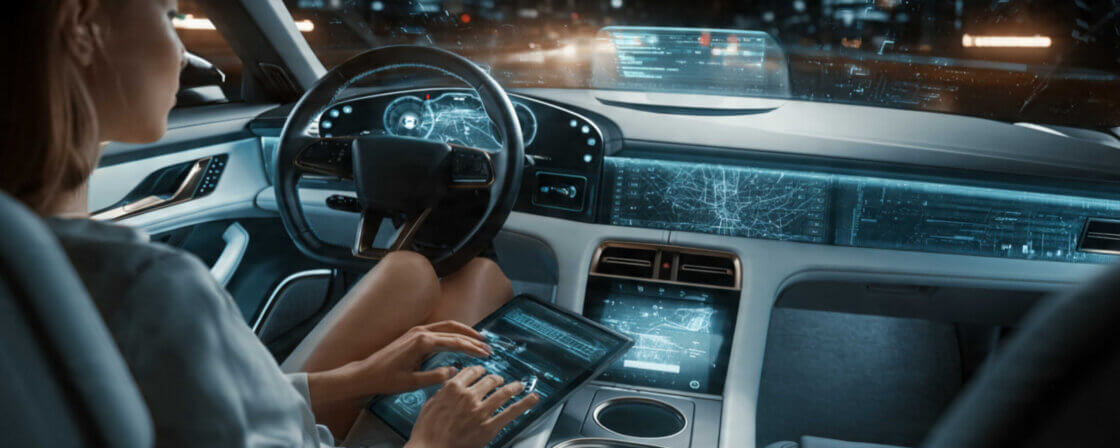
Today, the first part of this future has already arrived. Starting in January 2026, vehicles with SAE Level 3 automation—which, under certain conditions, will actually take over control—will be allowed to legally operate on Czech roads. Meanwhile, manufacturers and ride-hailing platforms are preparing European fleets of SAE Level 4 robotaxis—vehicles that, in designated environments, will no longer require a driver at all. Bolt and Lucid, for example, have announced plans to deploy at least 25,000 such vehicles in European cities.
Sometimes, the driver really isn’t driving
The difference between today’s driver-assistance systems and a truly automated vehicle is legally significant. With conventional adaptive cruise control, lane-keeping assist, or, for example, Tesla’s FSD Supervised system, a human remains responsible for driving. With an SAE Level 3 vehicle, however, the car itself can take over driving under specified conditions.
Czech law has explicitly provided for this starting this year. While the vehicle is actually driving itself, the driver is not subject to the obligations fulfilled by the automated system. However, the driver must be prepared to take control again at any moment. If they fail to do so, the protection ends and responsibility reverts to them. Furthermore, the police can verify records to determine whether a human or the system was driving at any given moment.
This is quite a fundamental change from a world in which, after an accident, the first question was almost always: What did the driver do wrong?
But the “car” won’t be held responsible for the accident
Earlier concepts sometimes relied on a simple equation: when a human stops driving, the machine assumes responsibility. Legally, of course, it’s more complicated. The car itself won’t pay any compensation, nor will it appear in court.
Czech legislation already addresses, for example, liability for traffic violations in automated driving modes. However, when it comes to damages caused by an accident, depending on the circumstances, the vehicle operator, the insurance company, the manufacturer, or liability for a defective product may come into play. The more control the software takes over, the more important it will be to determine exactly what the car was doing at the moment of the accident, what data it had available, and whether the system was functioning as it should.
Instead of witness testimony such as “he was driving too fast and wasn’t paying attention,” future disputes may increasingly resemble a technical analysis of data, sensor readings, and software updates.
Robotaxis Are No Longer a Philosophical Experiment
The next step is SAE Level 4. Such a vehicle can handle the entire driving process on its own within a defined area and does not require a human ready to take the wheel. This is where true robotaxis belong.
Czech law is not yet fully prepared for this phase. However, the Ministry of Transport plans to further develop the legal framework so that SAE Level 4 vehicles can be operated as early as 2027. At the same time, the European Union has already established technical rules for the type approval of fully automated vehicles.
Early debates about self-driving cars often centered on the well-known moral dilemma: what should a car do if it can save its passenger only by endangering someone else? Such questions have not gone away, but the actual legal developments so far are far less dramatic than what we see in the movies. Regulators are primarily addressing how to safely approve a vehicle, who is authorized to decide on its behavior, how to record data, and who will bear responsibility if the system fails.
Are you solving a similar problem?
Solutions Tailored for You
Our team of experienced attorneys will help you solve any legal issue. Within 24 hours we’ll evaluate your situation and suggest a step-by-step solution, including all costs. The price for this proposal is only CZK 690, and this is refunded to you when you order service from us.
I Need help
- When you order, you know what you will get and how much it will cost.
- We handle everything online or in person at one of our 6 offices.
- We handle 8 out of 10 requests within 2 working days.
- We have specialists for every field of law.
So what about all those lawyers without jobs?
This prediction hasn’t come true yet either. If automation does indeed reduce the number of accidents caused by human error, some of the traditional disputes between drivers may eventually disappear. At the same time, however, a whole new set of legal issues is emerging: manufacturer and operator liability, insurance for autonomous fleets, evidence based on vehicle data, cybersecurity, software updates, and the protection of the vast amounts of data that autonomous cars collect while driving.
So the driver may indeed gradually become a passenger. But the lawyer—not yet.