Quick overview
In Czech law, a container house is not judged according to the fact that it was created from a shipping container, but according to whether it fulfils the characteristics of a building and what purpose it is intended to serve. If you want to live in it, rent it out, or use it as a holiday home, you have to deal with the building law, the zoning plan, the connection to networks, the fire safety solution and the energy performance.
The most important rules are:
- A small container on the property does not automatically mean building without permission.
- For small buildings, precise limits must be met, for example a built-up area of up to 40 m² and a height of up to 5 m.
- In most cases, a residential container house will require planning permission.
- Always check the land plan, driveway, utilities and legal defects with the land registry before buying a plot.
- For a new house, you will usually also be dealing with a PENB, or building energy performance certificate.
Are you planning to buy a plot or have you already chosen a container house? Have the purchase contract, the land registry and the legal possibilities of construction checked beforehand. You will save yourself the situation when you buy a plot of land on which your dream house cannot be legally built at all.
What is a container house
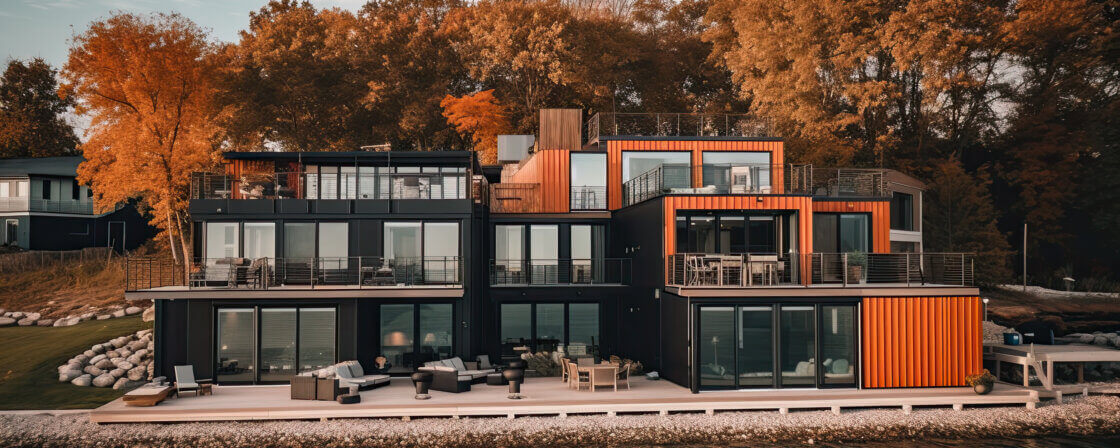
A container house is a type of building created by converting large shipping containers into residential or commercial space. Shipping container homes offer sustainability, affordability and design flexibility. They can be built quickly and adapted to different architectural styles. However, it must be taken into account that even container homes are subject to building regulations.
Container houses and legislation
Container houses are primarily covered by building law. The fact that it is a modified shipping container is not decisive. What matters is whether the result is a building, where it will be located, how it will be connected to the land and networks and whether it is to be used for housing, recreation, business or just as an accessory building.
In particular,the new Building Act distinguishes between
- minor,
- simple,
- reserved
- and other buildings.
A small container building may in some cases fall within the category of small buildings, which do not require planning permission. Typically, however, it must be a structure of up to 40 m² built-up area and up to 5 m in height, with no more than one storey above ground, located on the plot of a family house or a structure for family recreation which is related to the dwelling or recreation.
At the same time, the building is not a building for a business, the setback distance from the property boundary must be respected and sufficient area must be left for rainwater harvesting after its location.
Please note: The fact that a container meets the dimension of up to 40 m² is not sufficient in itself. If you want to use it as a separate house for permanent living, a holiday cottage or a rental property, it may already be a project that will be considered more strictly by the building authority. In practice, therefore, it always depends on the purpose of use, location, technical design and the municipality’s zoning plan.
For a conventional container house, therefore, you should rather expect to need planning permission. The building authority will deal with similar issues as for a brick house or a wooden house: compliance with the zoning plan, access to the land, connection to electricity, water and sewage, fire safety, hygiene requirements, design documentation and the energy performance of the building.
In our practice, we most often encounter that the client deals with the legal aspect of alternative housing only after the land has been purchased or the container has been ordered. It is only then that they find out that the zoning plan in the area does not allow for this type of housing, that there is no legally secured access to the land, or that connecting to networks will be more complicated than they originally expected.
It is also a typical mistake to think that a ‘mobile’ or ‘container’ building does not automatically require planning permission. However, this is not how it works. If the object is realistically used as a structure for housing or recreation, the building authority will address its purpose, technical design and impact on the surrounding area, not just the fact that it was created from a shipping container.
Not sure if your container house is a small building or if you already need planning permission? Send us the documents for the plot and the planned construction. We’ll check legal risks, land registry, contracts and basic compliance with building regulations before you pay a deposit for the land or the container itself.
Tip for article
In case you are going to buy a plot of land to place a container house, it pays to get the help of an attorney. We will provide you with a complete contractual and legal service related to the purchase of the property. We can handle it within 48 hours, flawlessly and professionally.
What to prepare for planning permission:
The specific scope of the documents will vary depending on whether the project is a small building, a simple building or a more complex project. However, for a container dwelling, you can usually expect that the building authority will want the following documents and information in particular:
- Details of the plot,
- details of the planned construction, its purpose and scope,
- the expected date of commencement and completion of the construction,
- proof of the project’s compliance with the zoning plan or other planning instrument,
- binding opinions of the authorities concerned (such as the Ministry of the Environment or the National Heritage Institute),
- binding opinions of the owners of transport and technical infrastructure (here it concerns the connection of the construction to power lines, water supply, etc.),
- project documentation (drawings, technical solutions, etc.),
- a draft plan for the inspection conditions of the construction,
- a declaration from the construction manager (if you are rebuilding the containers on your own),
- a location drawing and, if necessary, the consents of the owners of neighbouring land or persons affected by the construction, if they are needed for the procedure.
Tip for article
Applying for a building permit can be a nightmare. Find out what you need to do, where to do it, and what you can expect if you don’t get the right permit and decide to build in the dark.
In older articles you may come across the terms building notification or building permit. However, in the context of the new Building Act, it is more accurate to talk about planning permission and whether a particular building falls under the category of small, simple or other buildings.
Moreover, the transition to the new legislation has in practice brought situations where the interpretation of individual authorities may differ depending on the specific design of the construction. For a container house, we therefore recommend not to rely on general information from the internet, but to check the specific plot and the specific project.
In our experience: cheap land can become more expensive
A client looked for a cheap plot of land on the outskirts of a village and wanted to put a small container house on it for recreation. The seller assured him that “no permission was needed for the container”. However, upon inspection we found that the land was not zoned for recreation or housing, had no legal access, and connecting to water would require additional agreements with neighbors.
Thanks to the inspection before signing the purchase contract, the client backed out of the purchase and avoided a situation where he would have owned land on which the intended housing could not be legally implemented. It is therefore recommended that legal checks be carried out before signing a reservation or purchase contract, especially for alternative buildings.
Energy intensity
When building a container house, you must also take into account its energy performance. All new buildings must have a building energy performance certificate or PENB. This shows how much energy the house uses to run and therefore determines its energy performance and the associated environmental burden. You must pay particular attention to the thermal performance of the house, heating, water heating and cooling. Newly built houses must not have an energy performance higher than class B (i.e. they must have almost zero energy consumption).
If your container house has an energy reference area (= external floor area) of up to 50 m2, then you do not need an energy label.
But with a container house, there is no need to worry about energy consumption. It can easily be converted to low-energy or even passive. The overall result depends primarily on the design of the façade. But other factors that also play a role are: orientation to the cardinal points, the use of renewable energy (e.g. in the form of solar panels) and the simple shape of the building (which is guaranteed for containers)
Advantages and disadvantages of houses made of shipping containers
Advantages
- Sustainability: container homes convert new or discarded shipping containers into something new, an eco-friendly form of upcycling that reduces the need for new building materials.
- Affordability: Compared to traditional homes, container homes tend to be more cost-effective (especially when using discarded containers).
- Fast construction: Container homes can be built relatively quickly because the basic structure is already in place.
- Design flexibility: With customization, container homes can be tailored to suit your style and needs.
- Modularity: shipping containers are modular building blocks that make it easy to expand or customize living spaces. You can build your house in sections.
- Relocatability: container homes can be designed to be transported to different locations.
- Strength and durability: shipping containers are designed to withstand the rigors of transportation, making them very durable.
Are you solving a similar problem?
We can help you solve the problems you have
Whether you need help with buying the land on which to place the container house, registering it with the Land Registry or anything else, we are here for you. We can provide you with a complete contractual and legal service related to the purchase of the sale of the property. We can do it within 48 hours, flawlessly and professionally.
I want to help
- When you order, you know what you will get and how much it will cost.
- We handle everything online or in person at one of our 6 offices.
- We handle 8 out of 10 requests within 2 working days.
- We have specialists for every field of law.
Disadvantages
- Insulation and comfort: Containers are most often made of steel, which can lead to temperature extremes. Therefore, proper insulation is essential to make them habitable year-round in our conditions
- Size limitations: the dimensions of shipping containers can be limiting in terms of interior space. Therefore, if you want a large house, you will need to get more containers.
- Design limitations: the industrial look of shipping containers is not for everyone and extensive modifications may be required to achieve the desired aesthetics.
- Permits and regulations: Even if you use shipping containers for housing, you must comply with all building codes.
- Professionals and services: plumbing, electrical and other systems may require specialized installation. This will make it harder to find tradesmen and you will probably pay extra for their work.
- Transportation costs: If containers need to be transported to a remote location, shipping can get quite expensive.
- Limited space for windows and doors: Adding windows and door openings is more difficult and costly because of the steel construction of the container.
Tip for article
Alternative housing is also offered by mobile homes. Read what to look out for when buying a mobile home, how mobile homes are regulated by legislation and what to look out for when renting them.
Where container houses are sold
Some companies offer ready-made container houses, including wiring and insulation. However, if you want maximum freedom in design and the lowest possible price, it is worth building a container house yourself.
You can purchase shipping containers from a variety of sources, including
- Container suppliers: many companies specialize in selling new and used shipping containers.
- Ports: shipping containers are usually available at major ports. In the Czech Republic, you can find ports where containers are handled in Melnik or Ústí nad Labem or you can travel abroad to find a container.
- Online bazaars. However, be sure to inspect the containers thoroughly before buying.
- Auctions: shipping containers can sometimes be found at auctions Check local auction listings or websites for upcoming events.
- Shipping companies: shipping companies themselves may also sell containers. However, these will usually only be retired containers that are no longer suitable for shipping.
Tip for article
Even with a container house, you cannot avoid a proposal for entry into the Land Registry. We will help you with the drafting so that everything is in order the first time and you do not miss important deadlines or lose money.
What to look out for when buying
When buying a shipping container, consider the following factors:
- Condition: shipping containers come in a variety of conditions, including new, used and already converted to a container house.
- Size: Shipping containers are available in a variety of sizes, with six-foot and 12-foot containers being the most common.
- Price: prices can vary depending on factors such as size, condition and where the container is sold.
- Delivery: consider the cost of shipping the container to the desired location.
- Licensing and Regulations: Study all regulations and conditions for placing containers on your property beforehand.
Don’t rush into the purchase, think things through properly first, or even get a professional to help you. After all, you are buying your future home.
Summary
Under Czech law, a container house is not judged by the fact that it was created from a shipping container, but by its purpose, location and technical design. A small accessory building may fall under the category of small buildings if strict conditions are met, but a regular residential or recreational container house usually requires planning permission under the Building Act. Prior to construction, it is necessary to verify the zoning plan, access to the land, connection to utilities, fire and hygiene requirements, design documentation and energy performance. The greatest risk arises when a buyer acquires a plot or container before verifying that the building can be legally located and used. Therefore, it is worthwhile to have the legal status of the land, the contract and the connection to the planned construction project checked before signing the purchase or reservation contract.
Frequently Asked Questions
Can I live in a container without a building permit?
In most cases, no. If the container is to be used as a house for living or recreation, the building authority will consider it under the Building Act. Only some small buildings that meet the exact legal conditions will do without a permit.
Is it enough to just put the container on the land?
It is not enough to look only at whether the container is firmly connected to the ground. The authority will mainly look at the purpose of use, technical design, location, connection to networks and impact on the surroundings. Even a building without a conventional foundation can therefore be assessed as a building.
Can I have permanent residence in a container house?
Yes, but only if the building is legally permitted and approved or used as a building intended for housing with an assigned description or registration number. For a small accessory building in the garden, this is usually not possible.
Can a container house be financed with a mortgage?
Sometimes yes, but it depends on the bank, the legal status of the land, the building permit, the registration in the land registry and the value of the collateral. Banks may be more cautious with alternative buildings than with conventional brick houses.
Do I have to register the container house in the cadastre?
If it is a building registered in the Land Registry, the registration will need to be addressed. It depends on the specific design, purpose and whether the building meets the conditions for registration. In the case of a dwelling house with land, it is advisable to address registration with a lawyer and a designer.