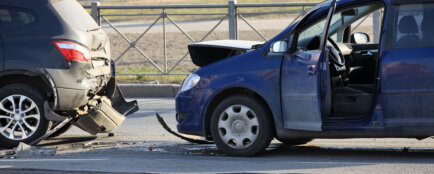
What You’re Entitled to After an Accident – A Quick Overview
As the injured party, depending on the circumstances, you may be entitled to:
- the cost of repairing the vehicle or its market value in the event of a total loss,
- compensation for damaged items being transported in the vehicle,
- reasonable expenses for a replacement vehicle,
- lost wages or lost profits,
- pain and suffering, medical expenses, and other compensation for bodily injury.
You generally file your claim directly with the insurance company of the vehicle whose operation caused the damage to you. However, it is not enough to simply state the total amount. You must describe each individual claim, provide supporting documentation, and prove its connection to the traffic accident.
Did the insurance company offer you less than the actual amount of your damages? We’ll help you respond and recover what you’re truly entitled to.
While traffic accidents are often viewed primarily as a matter of car repairs, the reality is much broader. If someone hits your car, you’re entitled to compensation not only for the vehicle itself but also for any other damages you’ve incurred—from items inside the car to physical injuries and psychological consequences. The Civil Code gives you the right to seek full compensation, regardless of whether it’s a minor accident in a parking lot or a more serious collision.
However, many victims are unsure of exactly what they can claim and how to proceed correctly so they don’t lose out on the money they’re entitled to. In the following text, you will therefore find an overview of what you are entitled to as a victim of a traffic accident, how compensation is handled through mandatory liability insurance, and what options you have for resolving the situation—from vehicle repairs to out-of-court settlements or
Compensable Damages
The injured party is entitled to claim full compensation for damages. This applies not only to property damage to the vehicle (clothing, luggage, and other items) but also to bodily injury, loss of life, and any non-pecuniary damages. The procedure is governed by the Civil Code.
This means that if someone crashes into you, not only will the cost of repairing your vehicle be covered, but also all other reasonable expenses you incurred as a result of the accident. Typical items include, for example:
- damage to items in the car (cell phone, laptop, luggage, clothing),
- injuries (pain andsuffering, medical expenses, loss of social functioning),
- lost income due to inability to work,
- non-pecuniary damages, such as psychological trauma following the accident.
How to File a Claim for Damages?
Claims for damages resulting from car accidents involve certain specific considerations. The first is the involvement of insurance companies, as mentioned earlier; another is the often high cost of the damage, the repair of which may even exceed the vehicle’s current market value. It is also not always possible to repair the car, thereby adhering to one of the basic rules of compensation for damages (the effort to restore the vehicle to its previous condition).
It is always necessary to assess the current situation, the extent of the damage, and the feasibility of repairing the vehicle. Subsequently, one of three methods for resolving the claim is chosen, namely:
- reimbursement of vehicle repair costs,
- a cost estimate for vehicle repairs, and
- total loss, or reimbursement of the vehicle’s market value.
Only reasonable and necessary expenses are reimbursed, a principle that has been repeatedly upheld by court rulings.
Under the law,vehicle repair is the most appropriate method of settling a claim. However, this approach is not always appropriate. If the car is too severely damaged and the cost of repair would exceed the vehicle’s market value, this approach does not apply. If, however, the insurance company’s claims adjuster chooses this option, they can typically also recommend the insurance company’s authorized repair shop, and after the repair is completed and an invoice is issued, the claimant can submit the incurred costs to the insurance company for reimbursement.
A cost estimate is the second possible method; in this case, the insurance company provides compensation equal to the estimated costs. To determine these costs, insurance companies use computer systems that contain the prices of replacement parts and the labor rates of auto repair shops.
If the price determined in this way differs significantly from the repair shop’s own estimate, it is appropriate to discuss the matter with the insurance company or, if necessary, obtain an additional estimate from another repair shop or a court-appointed expert.
You do not have to automatically accept the insurance company’s estimate as final. If it does not take into account standard labor rates, necessary parts, or the full extent of the damage, have the estimate reviewed to ensure the insurance company has correctly quantified the damage before accepting the settlement.
However, the insurance company should not reduce the estimate by substituting older replacement parts for new ones. It is not fair to require the policyholder to find replacement parts of a corresponding age (as has also been ruled in a number of court decisions).
Compensation for the vehicle’s market value (known as a “total loss”) is a situation that occurs, for example, with very old vehicles. In such cases, the cost of repairing the vehicle may far exceed its current (market) value, making it no longer cost-effective to repair it. In such a case, the insurance company determines the cost of purchasing a vehicle of the same type in a similar technical condition and year of manufacture, with comparable equipment, etc. The vehicle’s salvage value is generally deducted from this price. According to current case law, if the repair costs significantly exceed the vehicle’s usual value, the insurance company is not obligated to cover the repair costs, but only the usual value of the vehicle prior to the accident.
In practice, we frequently encounter situations where the claimant accepts the insurance company’s initial estimate without comparing it to a quote from an independent repair shop. A discrepancy may arise, for example, due to the omission of certain damaged parts, the use of a different hourly labor rate, or a different repair method. Therefore, we recommend requesting a detailed breakdown of the insurance payout, not just the final amount.
Tip for article
Tip: A traffic accident report—often referred to as an accident report or Euroform—is a key document when handling an insurance claim. How do you fill it out correctly?
Costs of Renting a Replacement Vehicle
The costs of renting a replacement vehicle are also covered if the injured party cannot use their own vehicle while it is being repaired. However, insurance companies generally monitor the repair period closely and are unwilling to cover costs for a period longer than is typically necessary for the repair in question. The claimant must also demonstrate a genuine need for a replacement vehicle, its practical usefulness, and the reasonableness of the rental price.
Injuries
Car accidents are not only associated with property damage but, unfortunately, also with bodily injury and loss of life. Medical treatment, surgery, or a hospital stay for the injured party will, of course, be covered by the health insurance company with which they are insured. However, the health insurance company may subsequently file a recourse claim either against the at-fault party’s commercial insurance company or directly against the at-fault party themselves.
In addition to medical expenses, the injured party may, depending on the consequences of the accident, claim, for example:
- compensation for pain and suffering,
- compensation for reduced social functioning due to permanent consequences,
- costs of care for the injured party and their household,
- loss of earnings during and after the period of incapacity to work,
- compensation for other reasonable expenses related to medical care,
- monetary compensation for the emotional distress of close relatives in the event of death or particularly serious injury.
The amount of compensation is not determined solely by mechanically applying a single binding table. The extent of the injury, the course of treatment, permanent consequences, and the individual impact of the accident on the injured party’s life are all taken into account. In practice, medical reports are used to quantify pain and suffering and permanent consequences, and the Supreme Court’s Methodology is also used as a supplementary guide.
In cases of bodily injury, an agreement reached too early may mean that it will not be easy to claim compensation for consequences that arise later. We will help you determine which claims to pursue and how to substantiate them to the insurance company.
Out-of-Court Settlement vs. Litigation
Many cases are resolved through an out-of-court settlement between the injured party and the insurance company following a traffic accident. However, if the insurance company refuses to pay or offers an inadequately low amount, it is possible to seek compensation through the courts. We’d be happy to help you negotiate fair terms and represent you in court proceedings.
Tip for article
Tip: The number of traffic accidents is increasing year by year, and although none of us wants this to happen, the likelihood that it will affect us one day is not entirely small. Do you know what to do in the event of a traffic accident?
Summary
If someone crashes into you, as the injured party, you are entitled to full compensation—not only for vehicle repairs, but also for items damaged inside the car, bodily injury, lost income, or emotional distress. Compensation is claimed from the at-fault party’s mandatory liability insurance and may take the form of vehicle repairs, reimbursement of repair costs, or a “total loss” payment (payment of the vehicle’s market value prior to the accident). In addition, you can request reimbursement for the rental of a replacement vehicle during the repair period. In the event of bodily injury, medical expenses, pain and suffering, loss of social functioning, or compensation for loved ones in the event of death are covered. The insurance company is obligated to cover reasonably incurred costs; it may not unjustifiably reduce the payout due to depreciation, and in the event of a dispute, the matter may be brought before a court. You must always call the police in the event of injury, damage exceeding 200,000 CZK, or if the parties involved in the accident cannot agree on who is at fault. In many cases, situations are resolved through an out-of-court settlement following a traffic accident, but if the insurance company fails to pay benefits correctly, you can seek fair compensation through the courts.
Frequently Asked Questions
What am I entitled to as the injured party in a traffic accident?
Depending on the circumstances, you may be entitled to vehicle repairs, the vehicle’s fair market value in the event of a total loss, compensation for damaged property, a replacement vehicle, lost income, and compensation for personal injury.
Do I have to accept the insurance company's budget?
You don’t have to. Request a detailed estimate and compare it with the repair shop’s quote. You can provide the insurance company with supporting documentation for any disputed items and contest them in writing.
Am I eligible for a loaner car even if I own a second car?
It depends on the specific circumstances. The insurance company will assess whether you actually needed a replacement vehicle and whether the rental cost was reasonable.
Can an insurance company reduce the payout because of new replacement parts?
Not necessarily. The use of new parts alone does not mean that the compensation amount must be reduced. The decisive factor is whether the repair actually increased the vehicle’s value beyond its pre-accident condition.
What if the car is cheaper after the repair than it was before the accident?
If it can be demonstrated that an accident has reduced the market value of the vehicle even after it has been properly repaired, you may be entitled to compensation for the difference in value.