The case ended up in the Supreme Administrative Court: Slapping as a misdemeanor
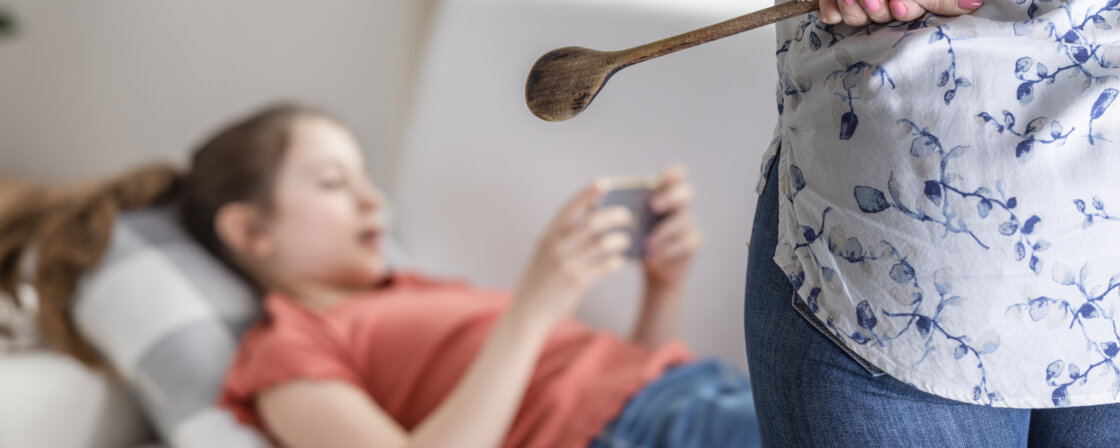
The case of a mother from South Moravia, which ended up before the Supreme Administrative Court (SAC), shows that even a seemingly “innocent” slap can have legal consequences. However, it should be stressed that this was not a one-off excess. According to the authorities, the woman had committed an offence by repeatedly physically punishing her eight-year-old son with a boiler on his bottom – at least twice a week for several months. Officials issued her with a warning and ordered her to pay 1,000 crowns in costs. But the mother did not agree.
She defended herself on the grounds that it was not violence, but an educational measure – and moreover that she was “only” defending herself against an aggressive son who was destroying the household and attacking her and her partner. She also claimed that it was not a cooking pot, but a lightweight wooden turner, with a humorous inscription “for the ass”. She therefore challenged the whole thing in court. The Regional Court in Brno, however, did not agree with her, so she appealed to the Supreme Administrative Court.
The Supreme Administrative Court rejected her arguments and upheld the decision of the authorities and the lower court. The key conclusion was that any corporal punishment of a child is an inappropriate educational measure because it interferes with the child’s human dignity. It is irrelevant by what means, how severely or in what circumstances the punishment was inflicted. Corporal punishment, according to the Court, is contrary to the principles of child protection, international conventions and the Charter of Fundamental Rights and Freedoms.
The case has thus become precedent-setting and sent a clear signal: even a “light spanking” can be an offence in the eyes of the law.
Are you solving a similar problem?
Representation in misdemeanour proceedings
Have you received a penalty or summons? The penalties can be high and it is not worth going through the process without consulting an attorney. Careful reasoning also pays off if you want to draw attention to someone else’s offence.
I want to help
- When you order, you know what you will get and how much it will cost.
- We handle everything online or in person at one of our 6 offices.
- We handle 8 out of 10 requests within 2 working days.
- We have specialists for every field of law.
What does the law say today – and what will change from 2026?
Although many parents feel they have the “right to direct their child as they see fit”, the legal reality is starker today than it might seem – and will be even clearer from 2026. While current legislation does not explicitly prohibit physical punishment, it already sets clear boundaries: no educational measure may endanger a child’s health, development or dignity (see Article 884(2) of the Civil Code).
What does this mean in practice? A slap, a smack, a tug on the arm – even if meant “in good faith” – may be considered disproportionate if it violates the child’s dignity. It is this interpretation that has been invoked by the Czech courts and authorities, and the Supreme Administrative Court has now upheld it as correct and fully in line with European case law.
As of 1 January 2026, the situation will become even more precise. A new presumption is added that the human dignity of the child is affected by corporal punishment, infliction of mental hardship or other degrading measures and the obligation of parents to take care without corporal punishment, mental hardship or other degrading measures
This change does not mean a completely new regulation, but rather a confirmation of what is already in place – just in a clearer way and without room for double interpretation. Above all, the amendment is preventive in nature: parents should be clear from the outset thatphysical punishment is not acceptable in any form.
The aim of the new regulation is to protect children from humiliating treatment, while at the same time giving clear guidance to parents on where “education” ends and violations of a child’s rights begin.
Tip for article
Have you committed the crime of battery? What penalties do you face and how much will you pay in compensation? Find out in our article.
Court: children have the right to dignity. Even at home.
The verdict of the Supreme Administrative Court (SAC) is in many ways groundbreaking. First of all, it has clearly confirmed what many parents may still be unwilling to admit: any corporal punishment of a child is a violation of his or her dignity and therefore an unacceptable means of education. This is the case even if the parent acts in good faith, “just” slaps the child on the bottom or feels provoked by the child’s aggressive behaviour.
The court relied not only on Czech law, but also on the case law of the European Court of Human Rights (ECtHR). According to the ECtHR, children also have the right not to be subjected to degrading treatment, even in the environment of their own family. It was the emphasis on the human dignity of the child that formed the core of the reasoning of the judgment. The SAC stated unequivocally that even “light” physical punishments cannot be considered proportionate – they are always inadmissible in the eyes of the law.
Crucially, the court refused to examine how often, how severely and under what circumstances the punishment occurred. In the Court’s view, the mere fact that corporal punishment took place constituted an interference with the child’s dignity. In other words, it is not important whether it was a boil, a turnbuckle or a hand – nor how badly the child “misbehaved”.
The decision thus sends a clear message: the home environment is not a legal vacuum. Children have rights at home too – and one of them is the right to dignity and protection from violence in any form.
What are the risks for parents who use physical punishment?
Many parents still think that “one slap does not kill anyone”. But in the eyes of the law, even a light smack can constitute a misdemeanour, and in some cases even a criminal offence. The Czech legal system protects children not only as persons in the care of their parents, but as independent subjects with the right to dignity, protection and security.
If a parent uses disproportionate educational means, for example corporal punishment, he or she may be punished under the Act on Social and Legal Protection of Children. The authorities can impose:
- a warning (as in the case of the mother mentioned above),
- a fine (with costs),
- or – in the case of repeated or more serious behaviour – propose the restriction of parental rights.
In serious cases of repeated beatings, abuse or psychological coercion, the parent may be charged with the offence of abuse of a person in his or her care (section 198 of the Criminal Code) or with endangering the upbringing of a child. Such acts are already dealt with by the police and the public prosecutor’s office – and are punishable by probation and even imprisonment.
It is important to note that anyone can report suspicions – a neighbour, a teacher, a doctor, even an anonymous whistleblower. In addition, the law imposes a reporting obligation on certain professions (e.g. teachers or health professionals). If someone knowingly fails to report child abuse, he or she may be committing the crime of failure to report.
In short – even “educational” violence is no longer without consequences.
How else to deal with conflict situations with children?
When a child does not listen, shouts or deliberately provokes, it is difficult to keep a cool head. Many parents reach for a “quick fix” at such a time – a slap on the bottom, for example. But experts and courts agree: violence in parenting is never the way to a healthy parent-child relationship. On the contrary, it leaves marks that a child can carry for life.
Physical punishment may induce immediate fear or obedience, but in the long term it erodes trust, lowers a child’s self-esteem and teaches him or her that violence is a common way of resolving conflicts. In addition, the parent is often caught in a vicious circle – the child resists, the child behaves worse, the parent gets tougher… and the problem gets worse.
However, there are a number of effective yet non-violent parenting approaches. The basics are:
- consistency (the child knows what he can and cannot do),
- positive motivation (praise often works better than punishment),
- calm communication (even in emotions),
- and the ability to ask for help – whether it’s a partner, a professional or a parenting course.
Today there are also programmes aimed at anger management, conflict resolution or improving communication within the family. Some courses are offered directly by the child protection authorities (OSPOD), others are run by non-profit organisations.
It is essential to know that the mistake is not in the parent getting into a crisis – but in the parent starting to solve it with violence. Respectful parenting is not about weakness. It is about the strength to handle difficult situations with reason and empathy.
Summary
In its decision, the Supreme Administrative Court confirmed that even seemingly “innocent” physical punishments, such as a slap on the bottom, constitute a disproportionate interference with a child’s dignity – and therefore a violation of his or her rights. It does not matter how hard the parent hits the child, what he or she does it with, or what the circumstances were. The act of physical punishment itself is legally impermissible.
Although the Czech Civil Code will not explicitly prohibit corporal punishment until 1 January 2026, it is already the case that no educational measure may humiliate a child or endanger his or her health and development. The amendment merely clarifies and makes this principle clearer – it is not a new obligation, but a confirmation of the existing interpretation of the law in line with European standards.
This case clearly shows that while parents have the right to raise their children, they also have the responsibility to respect their rights and human dignity. The use of physical violence – however mild – can lead not only to a reprimand or a fine, but also, in more serious cases, to the restriction of parental rights or criminal sanctions.
Instead of punishment, there are more effective and healthy ways to guide children and manage difficult situations. Respectful parenting is not a sign of weakness, but of strength – the strength to control emotions and treat the child as an equal human being.
Frequently asked questions
Is slapping a child on the butt really a misdemeanor?
Yes, even an “innocent” spanking can be considered an offence if it interferes with a child’s dignity. According to the Supreme Administrative Court, any corporal punishment of a child is automatically an inappropriate educational measure and therefore an unlawful act. It does not matter how severe the hitting was or what it was done with – what matters is that the child was physically punished. Such conduct may be dealt with as an offence under the Child Welfare Act.
But the law does not directly prohibit physical punishment of children - how can I be punished for it?
It is true that the current Civil Code does not explicitly mention the prohibition of corporal punishment. However, it already states that educational measures must not endanger the child’s health or affect his or her dignity. The courts and the authorities have interpreted this wording to mean that physical punishment always violates the dignity of the child and is therefore unacceptable. As of 1 January 2026, this interpretation will be explicitly included in the law – a clear rule with no room for doubt.
What do I face if someone reports that I use corporal punishment?
It depends on the degree and repetition of such behaviour. In milder cases, the authority may impose a warning and a fine. If the violence is repeated or severe, the situation can be dealt with by the OSPOD, the police or the court, which can restrict or even remove parental rights. In extreme cases, the parent may be charged with the offence of abuse of a ward or endangering the upbringing of a child.