Quick Overview
In 2026, you’ll be able to access the real estate cadastre for free online via the ČÚZK app. There, you can find basic information about the property, the owner, the parcel number, the area, the type of use, liens, easements, or ongoing proceedings. However, before purchasing a property, it’s not enough to simply check the title deed. It’s also worth reviewing the title of acquisition, the purchase agreement, any restrictions, joint marital property, and the risk of legal defects that haven’t yet been registered.
Are you planning to buy a property or file an application for registration? Have a lawyer review both the contract and the information in the land registry. We’ll help you identify legal defects before you sign any documents or send any money.
What Is the Real Estate Cadastre?
The Land Registry Act defines what the Land Registry is. The Land Registry is a publicly accessible register that allows for the inspection of land parcels, buildings, and legal relationships. For quick access to information, you can use the online Land Registry search.
This data is used primarily to protect property rights, determine property values, protect the environment, and for tax and fee purposes. People most often search the cadastre for extracts, but thanks to archival documents, they can also obtain other documents that have been issued for a given property. In the Land Registry, you will find:
- Titles of acquisition, such as inheritance, purchase, or gift deeds,
- survey plans,
- mortgage agreements,
- occupancy permits,
- declarations by owners, and
- documents regarding easements.
Are you solving a similar problem?
Are you planning to file an application for registration in the real estate cadastre?
We’ll help you draft it so that everything is in order the first time around and you don’t miss any important deadlines or lose any money.
I want to help
- When you order, you know what you will get and how much it will cost.
- We handle everything online or in person at one of our 6 offices.
- We handle 8 out of 10 requests within 2 working days.
- We have specialists for every field of law.
How to Access the Real Estate Registry
Accessing the real estate cadastre has never been easier. Thanks to modern technology, you can now access the real estate cadastre from anywhere—all you need is an internet connection. The current cadastre is fully digitized, allowing you to easily access information about any property from the comfort of your home.
To access it, simply visit the website of the State Administration of Surveying, Mapping, and Cadastre (ČÚZK), where you’ll find the option “View the Real Estate Cadastre.” This option is often referred to as the “online cadastre” or “viewing the real estate cadastre online.” Here, you can search by parcel number, building, or residential unit, or simply open the entire map. Access is free, and you do not need to register to view basic information. However, as of August 1, 2024, some more detailed information (such as data from the “Information on Proceedings” section) will be available only to logged-in users via Citizen Identity or a customer account.
Regularly consulting the real estate cadastre can help prevent unnecessary legal disputes. If you prefer in-person contact over an online environment, you can also use the traditional method of consulting the cadastre by visiting one of the cadastral offices. In this case, however, you will need to provide basic information about the property you are searching for in advance. Specifically, this includes the cadastral area or municipality name and house number, the parcel number, or the case reference number.
Cadastral Map – A Great Tool
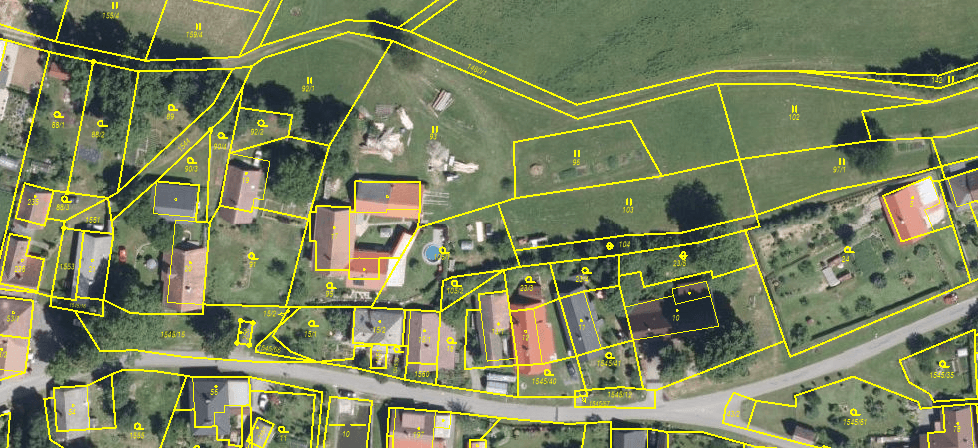
The cadastral map is an indispensable tool for viewing the real estate cadastre online. It is available in digital form on the ČÚZK website, but you can also use Mapy.cz with the cadastral map layer enabled, or the ikatastr app. You’ll find a wealth of useful information plotted on it, such as:
- boundaries of local administrative units,
- property boundaries,
- boundaries of protected areas,
- boundaries of protection zones,
- building perimeters,
- other features—tunnels, bridges, access roads.
Once you’ve found a specific parcel, you can access information from the land registry with just a click. The measurement feature may also come in handy. It allows you to measure various distances and verify the size of parcels. Thanks to the online land registry service, you can now check real estate information anytime, anywhere.
A Look at the Real Estate Registry – What You’ll Learn
A search of the real estate cadastre will provide you with information about the property owner as well as any encumbrances, such as easements or liens. For the owner, you’ll find their first name, last name, andpermanent address, as well asdetails about the property itself, such as the parcel number, house number, or unit number and their area.
When planning to purchase a property, it’s important to consult the Land Registry to avoid legal issues. Regularly checking the Land Registry can help you detect discrepancies or changes in ownership rights early on. Before signing any contract, we recommend checking the land registry to avoid unpleasant surprises.
This way, you can verify that you are indeed purchasing the property from the rightful owner. Another important piece of information is any restrictions on ownership rights that apply to the property, such as easements or liens, which may affect the sale or purchase of the property.
We know from experience that people often check only the owner’s name and consider the verification complete. However, the biggest problems are often hidden in restrictions on ownership rights, in titles of acquisition, or in contractual documentation, which a standard land registry search does not reveal. When purchasing real estate, we therefore recommend treating the land registry as an initial screening step, not as a comprehensive legal review.
Unfortunately, there is also information that cannot be obtained from the land registry. For example, you will not find out there that one of the owners has had their right to dispose of the property revoked. We therefore recommend requesting a document from the land registry that proves the owner’s title to the property—such as a purchase agreement or deed of gift—on the basis of which the owner acquired the property. Any restrictions may be listed in this document.
Not sure exactly what the title deed or title of acquisition indicates? Send us the documents, and we’ll clearly explain whether the property is legally sound, what needs to be added to the contract, and what risks to watch out for before signing.
Tip for article
Tip: Are you planning to buy a property? We’ll provide you with comprehensive contractual and legal services related to the purchase. We’ll handle it within 48 hours, flawlessly and professionally.
You also cannot determine from the extract from the title deed whether the owner is required to offer the right of first refusal to the other co-owners when selling a share in the property—information that is mandated directly by law. Another complication may arise when the property being sold is registered in the land registry under only one spouse’s name, even though the property is part of the spouses’ joint property. In such a case, the other spouse—who is not listed as the owner in the land registry, even though they are the actual owner—must expressly consent to the sale. The bank will always require this consent if you are purchasing the property with a mortgage loan.
You also cannot determine from the land registry extract whether there are any enforcement proceedings that have not yet been registered or are pending—proceedings that are ready to be filed with the enforcement officer and may thus appear on the title deed even before you acquire ownership. This information can only be obtained directly from the owner, who is obligated to disclose all legal defects of which they are aware, including the aforementioned enforcement proceedings that have not yet been recorded in the land registry.
What to Watch Out For: The land registry reflects the status as of a specific point in time; it does not show all risks that may arise shortly after the contract is signed. In practice, therefore, for higher-risk transfers, we recommend combining a land registry check with a background check on the seller, appropriately structured escrow, and contractual representations by the seller regarding the absence of debts, enforcement proceedings, and other legal defects.
Real-life example: The buyer verified the title deed and found no significant encumbrances in the Land Registry. It was only upon reviewing the contractual documentation that it became apparent that the property being transferred was part of the spouses’ joint property, and the consent of the other spouse would be required for the sale. Without this review, the bank might not have approved the mortgage, and the entire transfer could have been significantly delayed.
Changes to Information in the Land Registry
Changes to the land registry can occur through an entry, a note, or a record. If you are purchasing a property, an entry in the land registry will be relevant to you. It is only upon registration in the land registry that you become the official owners of the property. For municipalities and businesses as well, consulting the land registry is an important source of information when planning investments or construction projects. Before any transaction, it is therefore advisable to consult the Land Registry to verify all important information about the property. If you plan to make an entry in the Land Registry, you must prepare all necessary documents and information about the property.
How to Make an Entry in the Land Registry
A request to initiate the registration process must be submitted using the prescribed form. The application can be submitted in person at the land registry office, by mail, or electronically via a data box or the ČÚZK online application; electronic submission is subject to a lower administrative fee. In the application for registration in the land registry, you must provide several key pieces of information:
- Cadastral Office: Here, you must specify the specific cadastral office under which the property falls.
- Parties to the registration proceedings: These are typically the parties to the contract, such as the seller and buyer or the donor and donee. Individuals must provide their first name, last name, permanent address, date of birth, and personal identification number. Legal entities must provide their name, registered office, and identification number.
- Description of the real estate and rights to be registered in the cadastre: This section must include information clearly defining the real estate or its parts, i.e., the cadastral area, municipality, house number, parcel number, or registration number, or, if applicable, the apartment unit number. You must then attach to the application one copy of the document with officially certified signatures, on the basis of which the rights are being registered (e.g., a purchase or gift agreement).
If you wish to enter a record of a new structure into the land registry, you must fill out the land registry form titled“Notification of a Change in Land Data”and submit a geometric plan certified by the cadastral office, a notice of completion of construction or a final occupancy permit, and the municipality’s decision on the assignment of a house number.
The cadastral office has a maximum of 30 days to process your application . The administrative fee is usually 2,000 crowns, but if you submit your application electronically , you can take advantage of a reduced rate (currently 20% lower). You can pay it in person at the Land Registry (including by credit card) or by mail using a revenue stamp. And to avoid having to pay it multiple times, it’s best to seek help from experts. As part of our service, we’ll help you draft the application for registration in the Land Registry so that everything is in order the first time around and you don’t miss important deadlines or lose money.
Tracking the Registration Process
Once you submit an application for registration in the land registry, you can begin tracking the progress of the proceedings. This can be done online and free of charge on the ČÚZK website. All you need is the case number assigned to your application by the land registry office and the name of the land registry office responsible for the property in question.
And if you want to make tracking even easier, you can use the service for monitoring changes to property data in the Land Registry. This service is available online and free of charge on the ČÚZK website. It will automatically notify you of changes regarding your property via a data box, email, or text message. Access to this service is limited to individuals who are registered as owners of the property, holders of a right in rem, or parties to the proceedings.
Viewing the real estate cadastre online is quick and convenient. We recommend using the official ČÚZK website, where free access to the land registry is completely secure. If you’re unsure how to properly search the land registry, you can consult experts who will help you interpret the information you find.
Real estate transactions often involve millions of crowns. The land registry is an excellent source of information, but it cannot, on its own, replace a legal review of contracts, escrow arrangements, or the risks associated with the seller. If you want to ensure that the transfer proceeds safely, contact us before signing.
Summary
The Land Registry is a publicly accessible register containing important information about real estate and its legal relationships. You can access the Land Registry for free online or in person at a Land Registry office. In the event of changes, such as the purchase of a property, it is necessary to submit the prescribed form for registration in the Land Registry. The progress of the registration process can be tracked online, and the change tracking service provides automatic notifications of changes in the Land Registry.
Frequently Asked Questions
Is it free to look up the real estate registry?
Yes, accessing the real estate cadastre is free. Basic information—such as details about owners, parcel numbers, and restrictions on ownership rights—is publicly available. Starting in August 2024, some more detailed information (e.g., regarding ongoing proceedings) will be available only to logged-in users via Citizen Identity or a customer account.
How long does it take to register a change in the real estate registry?
The Land Registry has a statutory deadline of 30 days to process the application. If the documents are complete and correctly filled out, the registration is usually completed within this timeframe. In the event of errors in the application or more complex proceedings, the deadline may be extended—the proceedings may be suspended until the errors are corrected.
How much does it cost to file an application for registration in the land registry?
The standard administrative fee is 2,000 Kč. However, starting in 2024, a reduced fee (currently 20% lower) applies when filing electronically via a data box or the ČÚZK online application. It is therefore worth submitting the application electronically.
What information can I not find in the real estate registry?
You cannot find information in the land registry that has not yet been recorded—such as pending foreclosures or other legal defects that have not yet been officially entered. Similarly, you won’t find information there about the owner’s contractual obligations that arise directly from the law (e.g., the obligation to offer a share to co-owners upon sale). Therefore, it is always advisable to also request the title deed (purchase or gift agreement).
Who can use the land registry change tracking service?
The change tracking service can only be used by a person who holds a registered real right to the property (e.g., the owner, a mortgagee) or is a party to the proceedings. The service is free and notifies users via data box, email, or text message of any changes concerning the property.
Can I reliably determine from the land registry that a property is risk-free?
Not exactly. The land registry shows registered rights and encumbrances, but it does not reveal all contractual risks, future disputes, unregistered enforcement proceedings, or defects in the purchase agreement. Before purchasing, it is therefore advisable to also check the title to the property, the contracts, and the seller’s legal status.
When will I become the owner of the property?
You do not become the owner by signing the purchase agreement, but only once the ownership right is registered in the real estate cadastre. That is why it is important to properly prepare the application for registration, the purchase agreement, and the escrow arrangement for the purchase price.