Quick overview
A driver has a chance of recovering damages, especially if they can prove that it was not just a long-standing road breakdown, but a defect in the passability of the road, i.e. an unforeseeable change that they could not have anticipated even if they were driving reasonably. On the other hand, the law does not, in principle, grant a claim for damage caused solely by the structural or technical condition of the road. The claim is made against the owner of the road, typically the state, county, municipality or private owner of a dedicated road. It is mainly the evidence from the scene that is decisive: photographs, precise location, witnesses and possibly a police report.
Not sure if your broken-down car situation will allow you to claim compensation? Contact the Affordable Lawyer Legal Advice Service to get a clear answer.
When a driver is entitled to compensation for a pothole
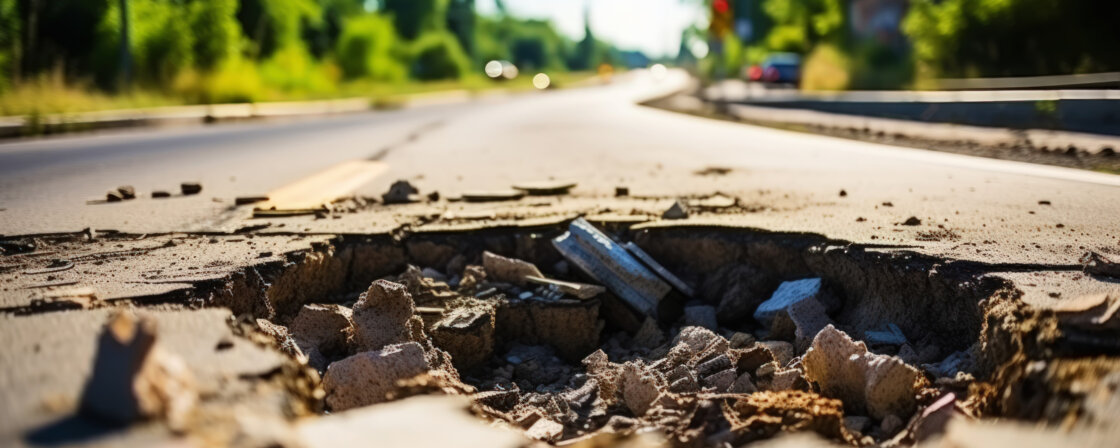
A claim for compensation for damage to a car caused by a pothole does not arise automatically every time a driver drives into a pothole. From a legal point of view, two different situations must be distinguished. The first is the long-term poor structural or traffic-technical condition of the road, i.e. a section of road that has been in poor condition for a long time, with a broken surface and repeated unevenness. The section is marked with signs that warn of the deteriorated road condition. In such a case, Section 27(1) of the Road Act explicitly states that road users are not entitled to compensation.
The second situation is more favourable for the driver. Section 27(2) of the Road Traffic Act provides that , in the case of a so-called defect in the passability, i.e. a sudden and unforeseeable change in the condition of the road which the driver could not reasonably have expected even when driving in a manner adapted to the road condition, weather and other circumstances (e.g. in practice, the main factors determining whether the pothole was foreseeable to the driver, whether the section was marked in any way and whether the driver adapted his driving speed to the particular situation. If, for example, the driver was driving through a place where there was a sign warning of unevenness in the road, the road owner will usually defend itself by saying that the driver should have driven more carefully. Conversely, in the case of a suddenly occurring and unmarked defect, the driver has a significantly higher chance of success.
Evidence is also crucial to a successful claim. The driver should take photographs of the damage to the car and the pothole itself, record the exact location and time of the incident and, if possible, secure witnesses. These details are often the basis of the entire dispute.
Are you solving a similar problem?
Are you dealing with damage to your car? Don't get cornered
Not sure if you are entitled to compensation or how much? In our legal advice centre, we will explain your rights clearly, advise you on how to proceed and how not to be put off – quickly, online and without unnecessary delays.
More information
- When you order, you know what you will get and how much it will cost.
- We handle everything online or in person at one of our 6 offices.
- We handle 8 out of 10 requests within 2 working days.
- We have specialists for every field of law.
Who is responsible for the damage and to whom to send the request
With pothole damage, the first practical question is simple: who to write to. Section 9(1) of the Road Traffic Act provides the legal basis. It states that the owner of motorways and class I roads is the state, the owner of class II and III roads is the county, the owner of local roads is the municipality and the owner of special purpose roads is a natural or legal person.
In everyday life, however, it is not always as clear as it looks in the law. Drivers often automatically write to the municipality just because the damage occurred “in the city”. However, a road through a municipality can still be a Class I, II or III road. A typical example: a car damages a pothole on a major thoroughfare through town and the victim sends a claim to the township. But the latter may correctly argue that it is not a local road, but a state or county owned road.
In practice, it is therefore worth checking at least these three things before sending a claim:
- what type of road it is,
- who owns it,
- whether the management is carried out by an administrator who handles the damage instead of the owner.
The latter is important. According to Section 27(6) of the Road Act , the damage may be paid by the road manager instead of the owner if the management is carried out by the road manager. The owner is then liable for the fulfilment of this obligation. For motorways and class I roads, this is often the case in practice, even if the state is the owner.
The practical experience is still the same: a well-described claim can waste weeks just because it has been sent to the wrong institution.
Tip for article
Tip: Total vehicle damage is one of the most common and most frustrating situations after a car accident. The insurance company will often label the car as “totaled” even if the owner doesn’t think so, or offer very low compensation. What does total loss actually mean, how is it calculated and when can you reject the insurance company’s conclusion?
What to do right after a pothole damages your car
The first few moments after a collision are more crucial than most drivers think. Not only for safety reasons, but also for what can be proven later. If you feel a jolt after hitting a pothole, the car starts to pull to the side or the tire pressure light comes on, it’s better to pull over safely as soon as possible and assess whether it’s even possible to continue. Further driving can make the initially minor damage to the disc, tyre or chassis much worse.
In terms of road traffic law, it is also important not to underestimate the accident mode. Section 47 of the Road Traffic Act stipulates when it is necessary to report an accident to the Czech Police. In particular, the police must be called if there are injuries, the damage appears to exceed CZK 200,000, damage to third party property occurs or traffic cannot be safely resumed.
In practice, we recommend ensuring the following without undue delay:
- the condition of the vehicle immediately after the incident,
- signs of damage, such as vibrations, air leaks or wheel deformation,
- evidence of towing, emergency repair or tyre replacement,
- a professional statement from the repairer that the damage is consistent with a pothole impact.
The most common error encountered in practice? The driver has the car repaired straight away and only then starts to work out what actually happened. But without a link between the state of the road, the damage to the car and the service, it is much harder to prove a claim.
How to claim and what must not be missing from the application
A claim for compensation should be a practical document, not an emotional complaint. The aim is to describe who is claiming damages, why they are claiming them here and how they are quantifying them.
The legal basis is usually based on Section 27(2) of the Road Traffic Act, according to which the owner of the road is liable for damage caused by a defect in the passability of the road unless it can prove that it was not within its power to remove, mitigate or draw attention to the defect in the prescribed manner. If you are basing your claim on this provision, it is a good idea to say so explicitly in the application, not just to say in general terms that you are ‘claiming compensation under the Act’.
A good application should include, in particular:
- identification of the victim and the vehicle,
- the exact location, date and time of the incident,
- a brief history of the situation,
- the specific amount and how you arrived at it,
- a list of attachments.
As a practical matter, it is also helpful to add one sentence as to why you believe it was not just the normal poor condition of the road, but the specific defect that led to the damage. This is where disputes like this often break down. Similarly, it makes sense to state explicitly whether you are also claiming ancillary costs, such as towing or necessary emergency repairs.
Send your request in writing, ideally so that you can prove delivery. And watch the time: the general limitation period under Section 629 of the Civil Code is three years. That sounds long, but in practice, documents and witnesses’ memories are lost much sooner.
When the communications manager usually refuses to comply
A negative opinion is the rule rather than the exception for these claims. It does not automatically mean that the driver is wrong. It mainly means that the road authority or its insurer will view the dispute restrictively and use all the usual defences.
The three most common are:
- it was not a defect in the passability, but a structural or traffic engineering condition of the road,
- the driver failed to adjust his speed in accordance with Article 18(1) of Act No 361/2000 Coll,
- the defect was marked or could not be removed or mitigated in time.
It is Section 18(1) of the Road Traffic Act that gives the administrator a strong argument: the driver must adapt his speed to his ability, the characteristics of the vehicle, the road condition, the weather and other foreseeable circumstances. Thus, if the other party proves that the section was marked or that it was a long-standing problem area, they often argue that the damage could have been avoided by driving more carefully.
In practice, litigation tends to be most complex where there are arguments on both sides. For example, where there is a ‘road roughness’ sign at the start of the section, but the pothole itself is extremely deep, difficult to see in the dark and the driver had no realistic chance of avoiding it safely. This is where it’s fair to admit that the law doesn’t always give a black and white answer and a lot depends on the details of the particular location.
Therefore, the injured party should always seek a refusal in writing and with specific justification. Only from that will you know if you need to add evidence, dispute the signage, or defend against the claim that the driver should have been driving differently. Without this, it is very difficult to decide whether it makes sense to send a supplement, a pre-action notice, or to close the case.
Summary
Damage to a car by a pothole does not automatically mean that the driver will receive compensation. In practice, it mainly depends on how the specific situation is legally assessed and how well the relevant circumstances can be proven. It is not enough to claim that there was a pothole in the road. It is essential to prove that this particular situation gives rise to liability on the part of the owner or manager of the road.
Several things are essential for success. First of all, it is necessary to correctly identify who has a claim to deal with, i.e. to whom the claim should be addressed. Equally important is the quality of the documents that the driver attaches to the claim. The more accurately the course of the incident, the extent of the damage and the link between the road condition and the damage caused are described, the less room there is for rejecting or disputing the claim.
Practical experience shows that the biggest weakness in such cases is not the damage itself, but insufficient documentation and an inaccurately formulated claim. Drivers often underestimate the capturing of the situation on the spot, the preservation of repair documents or the precise quantification of the damage. It is these details that determine whether a claim is considered valid or ends up being rejected.
It is therefore worthwhile to be factual and systematic and not to be discouraged by the first rejection. A rejection does not necessarily mean the end of the matter, but rather a signal that further argumentation or evidence is needed. The better the case is prepared from the start, the better the chances that the injured driver will actually recover the costs incurred in connection with the damage to his car.
Frequently Asked Questions
Do I have to deal with the damage right away, or can it wait?
It’s better to act as soon as possible. Evidence, witnesses and the exact condition of the site are harder to trace with the passage of time.
Just send an invoice for the repair?
It’s not enough. The invoice proves the amount of the damage, but does not in itself prove how and where the damage occurred.
Does it make sense to claim compensation even for minor damages?
Yes, if the damage is well documented and the claim has a real basis. But for small amounts, it is a good idea to consider whether the dispute is practically worthwhile.
What if the responsible party doesn't answer me at all?
In this case, it is advisable to send an urgent notice and then consider a pre-action notice.
Can I claim other costs besides car repairs?
Usually yes, if they are directly related to the incident and you can prove it, for example towing or necessary emergency expenses.
Is it better to deal with the insurance company or directly with the owner of the road?
Depends on the situation. If you have the right insurance, it may be quicker. But a direct claim can make sense where liability is well documented.
When does it make sense to contact a lawyer?
Usually when the damage is greater, the claim has been rejected or there is a dispute over who is responsible for the damage.