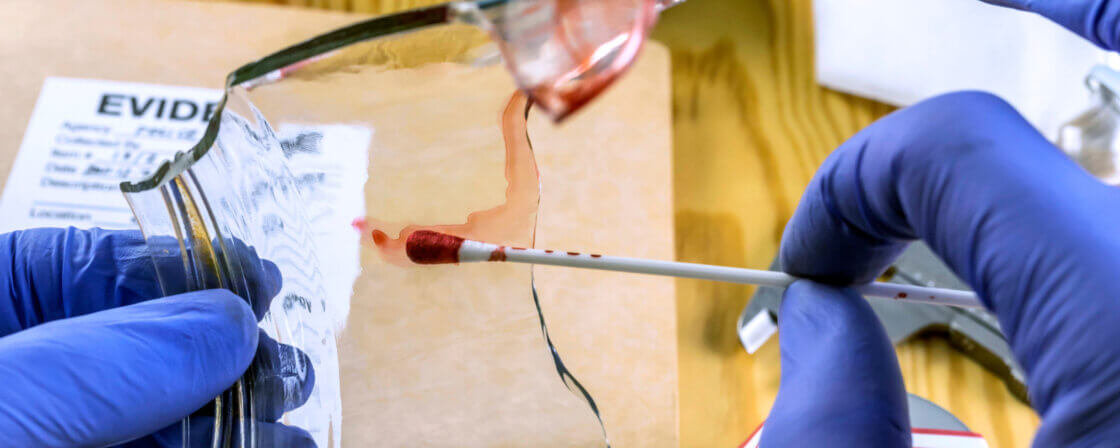
The above is also illustrated by the recently reopened Japanese case of Namiko Takaba. After the 1999 murder, her husband, Satoru Takaba, continued to pay rent for the apartment where the crime took place so that evidence would be preserved. Twenty-six years later, the police compared DNA from blood traces to a collected sample, and suspicion fell on a woman who had previously been a classmate of the victim. The case is significant not only on a human level but also legally: it demonstrates the importance of preserving evidence and advancing forensic methods, as well as the need to ensure that criminal liability has not expired due to the statute of limitations.
From Fingerprints to DNA: A Brief Excursion into the History of Forensic Science
Forensic science has always evolved alongside technology. Today, fingerprints seem like a matter of course to us, but at the time of their widespread adoption , they represented a major breakthrough. Dactyloscopy made it possible to link a specific person to a crime scene or an object without anyone having seen them directly. In the Czech lands, fingerprints began to be used more systematically at the turn of the 19th and 20th centuries and gradually became a standard part of police identification.
Forensic genetics brought about an even greater change. Older biological methods could often only rule a person out—for example, based on blood type. It was only with DNA analysis that it became possible to move closer to the individual identification of a specific person. The British case of the murders of two girls in central England is usually cited as the first-ever forensic use of DNA, where DNA analysis helped not only to find the perpetrator but also to exonerate an innocent suspect. The development of the polymerase chain reaction, known as PCR, then made it possible to work with even very small amounts of biological material.
Today, forensic science is no longer just about fingerprints and DNA. Forensic pathologists, geneticists, botanists, entomologists, and experts in digital forensics, ballistics, trace evidence, and chemical analysis are all involved in criminal proceedings. For the layperson, the most important thing to understand is this: science alone does not “convict” a perpetrator, but it can provide investigators and courts with new answers to old questions.
Are you solving a similar problem?
Lawsuit and representation in court
Need help with filing a lawsuit or representing yourself in court? Whether the litigation is just beginning or the case is well underway, we can help you with everything. We will conduct a thorough analysis, assess your realistic chances and suggest a course of action. All this within 48 hours of ordering our services.
I want to help
- When you order, you know what you will get and how much it will cost.
- We handle everything online or in person at one of our 6 offices.
- We handle 8 out of 10 requests within 2 working days.
- We have specialists for every field of law.
What modern methods are bringing old cases back into the spotlight today
The best-known method is DNA analysis. Modern laboratories are better equipped to handle minute or partially degraded evidence and, in some cases, mixtures of biological material from multiple individuals. This is particularly important in cold cases involving murder, rape, or violent assaults where blood, semen, saliva, hair roots, or other biological material has been preserved at the crime scene.
In addition to traditional DNA matching, there is increasing discussion of investigative genetic genealogy. This does not work by the police directly finding the perpetrator in a police database. On the contrary: an unknown DNA profile is compared with genealogical databases to identify family ties. These are then used to construct family trees that can lead investigators to a specific group of individuals. The method is powerful, but it is also sensitive in terms of privacy and the protection of genetic data. This is one reason why it is used under different legal conditions in various countries.
Genetic methods are not the only important ones. For example , the use of forensic entomology—the examination of insects found on a deceased person’s body— is particularly interesting . In some cases, it can help determine the time of death with a precision that a medical examiner alone cannot achieve. In one of the cases cited, entomologists helped determine the time of death of a 16-year-old boy found in a train car with an accuracy of about 14 days.
Another interesting Czech example is diatom analysis in drowning cases. Diatoms are microscopic algae that live in water. When a person is actually drowning, they inhale water, and diatoms can enter the lungs and other organs. Forensic investigators can then compare whether the composition of the diatoms in the body matches that of the location where the body was found. Czech forensic investigators and scientists have improved this method using filtration, which allows them to obtain more pure material and more accurate results.
Cases Where Old Clues Became New Evidence
The Satoru Takaba Case: An Apartment as a Time Capsule
Namiko Takaba was murdered on November 13, 1999, in an apartment in Nagoya. Her two-year-old son was also in the apartment and survived. At the time, police found traces of blood and fingerprints, which led them to believe the assailant might have been a woman. However , the case remained unsolved. Satoru Takaba moved out of the apartment but continued to pay the rent so that the scene would be preserved for future investigations.
A breakthrough did not come until years later. In 2024, the police reopened the case, narrowed down the list of suspects, and asked some of them for DNA samples. Kumiko Yasufuku, a former classmate of Satoru Takaba, initially refused to provide a sample, but on October 30, 2025, she did so. The following day, the police announced that her DNA matched blood traces from the crime scene and arrested her. It is important to note that this was not a case of genetic genealogy, but rather a direct comparison of DNA with a specific individual.
The case also highlights the legal significance of the statute of limitations. In 2010, Japan abolished the statute of limitations for murder and other most serious crimes punishable by death. Without this change, similar cold cases could have been subject to a time limit, even if strong evidence had emerged later.
The Czech Klučov Case: DNA After Thirteen Years
A Czech example is the 1990 triple murder in Klučov, in the Kolín region. The perpetrator murdered a mother and her two daughters. The case remained unsolved for years until investigators reexamined the biological evidence that had been collected. Thirteen years later, they were able to link the perpetrator to a DNA profile from the crime scene.
This case clearly illustrates why it makes sense to reexamine old case files and evidence. Neither the crime itself nor the crime scene had changed. What had changed were the tools available to investigators. According to later reports, the CODIS system for processing and storing genetic evidence—which the Czech Police began using for the National DNA Database—also played an important role.
Golden State Killer: The Power and Risks of Genetic Genealogy
One of the world’s most famous cases is that of the American Golden State Killer. Joseph James DeAngelo was identified decades later using DNA and genealogical databases. Investigators did not rely solely on a direct match in the police database but also used family ties and family trees, which gradually led them to a specific suspect. In 2020, DeAngelo was sentenced to life in prison without the possibility of parole.
This case brought genetic genealogy to the world’s attention. At the same time, however, it raised questions that are legally very sensitive: who can work with genetic data, whether people in genealogical databases know that their information can help identify a relative, and how to protect innocent individuals who appear in an investigation only as distant relatives.
Tip for article
How do you seek compensation for damages in criminal proceedings? When does it make sense to pursue criminal charges? How does the civil action in criminal proceedings work? What must the petition include? And when is it more practical to file a civil claim, work with an insurance company, or pursue administrative proceedings? We address these questions in our article.
In criminal proceedings, it is not enough to say that “science has identified the perpetrator.” Every piece of evidence must be lawfully obtained, properly secured, professionally evaluated, and then assessed in the context of the other evidence.
The Czech Criminal Procedure Code is based on the principle that law enforcement authorities must establish the facts beyond a reasonable doubt, to the extent necessary for a decision. At the same time, the principle of free evaluation of evidence applies: the court does not evaluate a single piece of evidence in isolation, but considers each piece individually and in its entirety.
In Czech criminal proceedings, anything that can contribute to clarifying the case may serve as evidence, particularly witness testimony, expert opinions, physical evidence, documents, and on-site inspections. This is particularly important in the context of forensic methods: a DNA profile, an expert opinion, seized evidence, or photographic documentation of a crime scene may be exceptionally significant, but the court always examines their origin, reliability, consistency, and alignment with other circumstances.
The Law Has Its Own Timeline: Statutes of Limitations and the Limits of Justice
Scientific advances raise a fundamental legal question: Can a perpetrator still be prosecuted many years later? Under Czech law, criminal liability generally ceases upon the expiration of the statute of limitations. For murder under Section 140 of the Criminal Code, the statute of limitations is 30 years. For other criminal offenses, it may be shorter, depending on the maximum penalty.
At the same time, there are offenses for which criminal liability does not expire upon the expiration of the statute of limitations, such as certain crimes against humanity, war crimes, or selected acts from the period of the communist regime under the conditions specified in Section 35 of the Criminal Code.
In older cases, therefore, it is not enough to simply say, “We have new evidence; we will reopen the case.” It is always necessary to assess what type of crime is involved, which legal provisions apply, whether the statute of limitations has already expired, whether it has been tolled, and whether the evidence will hold up in court. This is precisely where criminalistics intersects most visibly with criminal law.
Summary
Modern forensic methods give old cases a new chance. DNA, genetic genealogy, trace DNA analysis, forensic entomology, digital forensics, and specialized scientific methods can reopen questions that previously remained unanswered.
However, this does not mean that every old lead will automatically lead to a conviction. Criminal proceedings require legality, caution, and a chain of evidence. That is precisely why not only laboratories but also the proper preservation of evidence, case file management, expert opinions, the rights of the accused, and the assessment of the statute of limitations are essential.
The story of Satoru Takaba demonstrates human perseverance. The Czech Klučov case highlights the importance of preserved biological evidence. And the Golden State Killer case shows just how far forensic science can go when genetics, databases, and classic detective work come together. They all have one thing in common: justice doesn’t always come right away, but it can get a second chance when science moves forward.
Frequently Asked Questions
Can the police reopen an old, closed case?
Yes, if new facts, new evidence, or new ways of evaluating old leads come to light. In practice, however, this depends on whether the evidence has been preserved, whether it can be properly analyzed, and whether criminal liability has since expired due to the statute of limitations.
Is DNA always 100 percent proof?
DNA is very strong evidence, but it does not in and of itself lead to an automatic conviction. The court examines where the sample came from, how it was collected, whether contamination could have occurred, what the statistical significance of the match is, and whether it is consistent with the other evidence.
What is genetic genealogy?
This is a method in which an unknown DNA profile is compared with genealogical databases to search for relatives. Investigators then use family trees to narrow down the list of possible suspects. It is not, therefore, simply a matter of “searching for a suspect in a database.”