What is a descriptive number and what is it used for
The descriptive number is the basic identification of any building intended for housing, business or other registered activity. It is assigned by the municipality or municipal district when the building is approved and is entered in the Land Registry. It is the descriptive number that uniquely identifies a particular building, not the street or apartment, but the building itself. Therefore, when dealing with ownership relations, construction proceedings or registration of the property in public records, the descriptive number is always used.
In practice, this means that the descriptive number has direct legal significance. It appears in the extract from the land register, in purchase and lease contracts, in decisions of the building authority or, for example, in execution proceedings. Without a descriptive number, it would not be possible to officially identify the building as a separate object. Therefore, it may also happen that a new building cannot be fully used until it has been assigned a descriptive number.
From an ordinary person’s point of view, it is important to know that the descriptive number does not usually change even if the street name changes or the house is structurally altered. It serves as the “birth number” of the house and its main purpose is the legal and record identification of the building.
What is a landmark number and what is its meaning
Unlike the descriptive number, the landmark number is primarily intended for orientation within a street or public space. It is assigned by the municipality when the house is part of a street, square or other named road. The house reference number helps to quickly and clearly identify where the building is located and is crucial for navigation, delivery of parcels or intervention by the integrated rescue system , for example.
If anyone wonders what a landmark number is, the answer is simple: it is a number that makes sense primarily to people on the ground, not to legal records. It is typically shown in red or blue and is usually accompanied by a letter if there are several properties with the same number on the same street. The house reference number may change over time, for example when a street is renumbered or when it is newly built.
Although the landmark number does not carry as much legal weight as the descriptive number, its absence or incorrect indication can cause practical difficulties. An incorrectly entered landmark number can lead to non-delivery of mail, problems with registering a permanent residence or confusion when communicating with the authorities.
Are you solving a similar problem?
Not sure if your document has the correct description and reference number?
Are you dealing with permanent residence, registration of a company’s registered office or a problem with the delivery of official documents? Our advice centre will help you quickly and clearly. We will then check your documents, explain the differences in address from a legal point of view and propose a concrete solution so that a seemingly small thing does not cost you time or money. Just contact us.
I need some advice
- When you order, you know what you will get and how much it will cost.
- We handle everything online or in person at one of our 6 offices.
- We handle 8 out of 10 requests within 2 working days.
- We have specialists for every field of law.
Who assigns the descriptive and orientation number and according to which law
The assignment of a descriptive and landmark number is not governed by the arbitrary will of the municipality, but has a clear legal basis. The basic regulation is the Municipal Act and the ordinance on the numbering of buildings, according to which the municipality assigns a descriptive number to buildings intended for housing, recreation or other permanent use. The descriptive number is usually assigned after the completion of the building, or after the building has been approved or notified for use. Without an assigned descriptive number, the building cannot be fully registered in the Land Register.
On the other hand, the municipality assigns a reference number only if the building is located in a street or public space with a name. This means that in smaller villages or settlements, we often encounter houses that have only a descriptive number and no orientation number. This is not a mistake, but a perfectly normal and legally correct situation.
How to recognise the descriptive and landmark number directly on the house
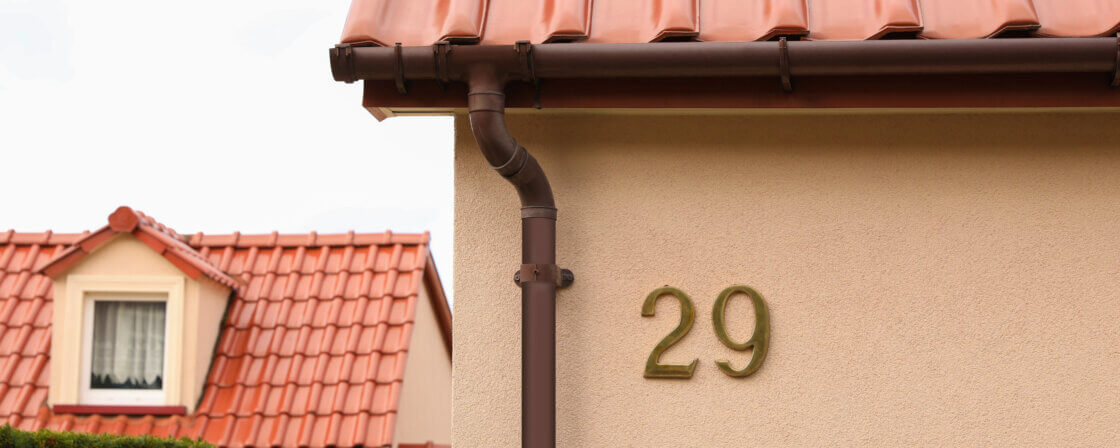
The law also lays down rules for the physical marking of the house. The descriptive number is marked in red and must be placed in a visible location, typically at the main entrance. The orientation number of the house is marked in blue and accompanied by the street name. It is the number after the slash. If a house has both numbers, they shall be placed side by side so that they are clearly legible from the public space.
Thus, in the case of a designation such as 213/11, 213 is the descriptive number and 11 is the orientation number.
The obligation to mark the house with the correct numbers lies with the property owner. If the number is missing, damaged or illegible, the municipality may impose a fine. This is therefore not just an aesthetic matter, but a legal obligation which is important for safety, delivery and orientation of the emergency services.
Specific situations: apartment buildings, multiple entrances and letters
Apartment buildings and buildings with multiple entrances deserve special attention. Each entrance may have its own orientation number, while the description number remains common for the whole building. A typical example is the situation where one apartment building bears the descriptive number 1200, but has orientation numbers 1200/1, 1200/3 and 1200/5 according to the individual entrances.
Another variation is letters for landmark numbers, for example 15A or 15B. These are used where development occurs between existing houses and it is not possible to retain the original number series. Even in these cases, the orientation number is primarily for orientation purposes, while the legal identity of the building is still determined by the description number.
Tip for article
Tip: Did you know that there are several types of addresses? The correct address plays a very important role in legal relations and everyday communication. Find out more about them.
Indicative and descriptive number: Why are they mentioned together
It is common to see the landmark number and the descriptive number next to each other in a common address, usually in the format of, for example, “25/7”. This notation is not accidental and has a good reason. These numbers together ensure both the legal identification of the building and its practical traceability in space. While the descriptive number tells what the house is in terms of registration, the landmark number identifies exactly where the house is located within the street.
This combination is essential, for example, when registering a permanent residence. The authorities require an exact address, which must match the information in the registers. If the landmark number is incorrect or not given at all, the application for permanent residence may be rejected or the whole process unnecessarily prolonged. Similarly, when entering into a tenancy agreement or changing the registered office of a business, getting both numbers correct is crucial.
What role do numbers play in permanent residence and dealing with the authorities
When you register your permanent residence, the address is entered in the population register and must correspond exactly to reality. The authority works primarily with the descriptive number as this uniquely identifies the building. However, the reference number is important for the correct assignment of the address within the street. If a building is identified only by a descriptive number without an orientation number, confusion can arise, especially in larger cities.
The landmark and descriptive number also play a role in the delivery of official documents. An incorrect address may lead to a parcel being deemed to have been delivered by fiction without the addressee actually knowing its contents. This can have serious consequences, for example in legal proceedings or in administrative offences.
Similarly, this information is important when registering the registered office of a company, applying for benefits, changing the details on an identity card or communicating with the tax office. All of these situations show that a correct understanding of the difference between a descriptive number and a reference number is not just a formality, but a practical necessity.
Tip for article
Tip: In practice, the delivery of a letter is a frequent source of legal disputes, especially when it comes to official or judicial documents that trigger the time limits for filing an appeal or enforcing a decision. Failure to receive a document does not necessarily mean that it has not been served.
When an incorrect number can cause a legal problem
An address error may seem like a small thing, but in legal practice it often leads to unpleasant disputes. A typical example is when only the landmark number is given in the contract or, on the contrary, the landmark number is missing for a house that is officially marked with it. Such an inaccuracy may call into question the unambiguous identification of the property and, in extreme cases, lead to disputes over the validity of the contract.
Problems may also arise in the case of foreclosure or auction of real estate, where it is necessary to determine exactly what object is the subject of the proceedings. If the details do not match the land registry, delays or legal challenges may arise.
If you are unsure whether your address is correct or if you are dealing with a problem with your permanent residence, lease agreement or registration in the Land Registry, it is advisable to consult a lawyer. A solicitor can assess whether the property identification is sufficient and help avoid future disputes. Often, a minor modification to the document is enough to avoid much bigger complications.
At Affordable Lawyer, we are used to situations like this. We can help you review contracts, communicate with the authorities or correct errors in official data so that everything is in line with the law and practice.
Summary
The descriptive number and the landmark number are essential components of an address, with each fulfilling a different but complementary role. The descriptive number is a permanent registration number assigned by the municipality that uniquely identifies a specific building and is of fundamental legal importance – it is entered in the land register, mentioned in contracts and used in building, ownership and official procedures. On the other hand, the landmark number is mainly used for orientation within a street or public space, can be changed and facilitates delivery, navigation and emergency services. In practice, the two numbers are given together, typically in the form of a descriptive number/orientation number, as this is the only way to ensure both the legal identification of the building and its unambiguous location. Correct indication of both the descriptive number and the landmark number is crucial when registering a permanent residence, communicating with authorities, concluding contracts or delivering documents, as mistakes in the address can lead to delays, disputes or even serious legal consequences.
Frequently Asked Questions
What is a landmark number and when does a house have one?
A landmark number is a number assigned to houses located on a street or named public space. It is mainly used for orientation and not every house may have one, typically missing in smaller villages or settlements without street names.
Is the description number mandatory for every building?
Yes, the description number is mandatory for buildings intended for housing, business or other permanent use. Without it, the building cannot be properly registered or registered in the Land Registry.
Can the landmark or description number change?
The descriptive number usually does not change and remains with the building throughout its “life”. On the other hand, the landmark number may change, for example, when a street is renumbered or when new construction takes place in its vicinity.
What problem can be caused by a wrong number in the address?
Incorrect or incomplete indication of a descriptive or landmark number can lead to non-delivery of mail, complications in residency, delays in official procedures or disputes over the validity of contracts.
Does the description and landmark number have to be visibly marked on the house?
Yes, the property owner has a duty to mark the house correctly. The description number is in red, the landmark number in blue along with the street name, and both must be legible from the public area or face a fine.